
10 Ways to Balance Work, Home, and Family as a Teacher Mom
As a teacher mom, it can feel impossible to balance work, home and family responsibilities. You’re always exhausted and there never seems to be enough time in the day. But it is possible to create balance in your life! Today, I’m sharing 10 proven ways to help manage your time and make life easier so you can have energy for your own home and family after the school day ends.

Why Juggling Teaching and Motherhood Doesn’t Work
Trying to juggle teaching and motherhood is a recipe for disaster.
Both jobs are so demanding, it’s like trying to be the CEO of two major corporations at the same time.
No wonder why so many teachers are experiencing burnout and leaving the profession.
Due to remote learning and staff shortages stress levels are at an all-time high in education, and there doesn’t appear to be an end in sight.
Giving 110% of your time, energy, and passion to your classroom and your family all day long isn’t sustainable.
On top of that, many of us feel guilty when we are torn between the needs of our students and our own kids and for wanting to spend quality time with our families.
This is especially true in a modern classroom where teachers are expected to be
- nurses
- counselors
- interior decorators
- trauma experts
- event planners
- parents and so much more….
Not to mention that after work you come home to:
- dishes
- laundry
- bills to pay
- clutter
- meals to cook
- and your own family members who deserve your time and attention
While finding a job outside the classroom may be the right choice for some, there are so many of us who truly love teaching. We’ve invested years of our life into education, training, and love working with children.
If you’ve been feeling like you’ve hit rock bottom and something needs to change, then you’re in the right place.
I know exactly how you feel because I am a teacher-mom too!
Along with running a first grade classroom, I am also raising two children, running two businesses, and continuing my education.
One comment I frequently hear is, “I don’t know how you do it all!” and my response is always the same: “I don’t”.
A few years ago I worked myself to the point of burnout and I knew something had to change.
I sat down for a few hours and made a master list of all the daily weekly and monthly tasks I was responsible for. This process proved that between school, home and family, I had taken on too much.
After spending a bit of time researching, and years implementing the strategies in my own life, I began sharing these tips with other moms who were feeling overwhelmed with work and motherhood.
I believe these strategies are essential for mothers who are also teachers because your classroom is quite literally like running a second household.
If you’ve been feeling like you can’t balance it all and would love to find some relief, keep reading!
The following are ten practical ways to balance work, home, and family as a teacher-mom:
How to Balance Teaching and Motherhood

1. Determine Your Priorities
The first step in creating balance is to determine your priorities. It’s time to sit down and clearly define what is most important to you.
While teaching and mothering have many important tasks, every responsibility is not and cannot be equally important.
Clarifying your priorities at home and in the classroom will help you to be more efficient and intentional with your time.
As a mom and teacher, there are always a million things you can do, but many of them are things we don’t actually have to do.
For example:
When you become more aware of what your priorities are it makes it easier to focus your time and energy on what truly matters.
- You can have perfectly decorated bulletin boards for each season, but you don’t have to.
- You can spend time mindlessly scrolling through social media on your phone, but you don’t have to.
- You can stop and chat with every co-worker you see on your way to the copy room, but you don’t have to.
This allows you to be a better manager of your time and helps you to determine which tasks you need to complete and which you can delegate, delay or delete from your to-do list.
Action Step: Sit down and make a bulleted list of your top priorities. Use this as a guideline to create your own “Must Do” and “May Do” lists for your home and classroom.
2. Set Up Systems

My first year as a teacher I spent a lot of evenings and weekends in my classroom. I was using this time to set up repeatable systems so my classroom could run smoothly and free up my time and energy in the future.
Setting up systems in your classroom (and at home) is essential if you are looking to create a work-life balance as a teacher.
For example:
At Home
– Create a cleaning schedule and stick to it.
– Meal plan and grocery shop accordingly.
– Establish morning routines for your children and yourself.
In the Classroom
– Have a designated place for materials that are always used (pens, pencils, scissors, glue sticks etc.)
-Set up a filing system to easily access curriculum and materials.
– Create routines that allow students to be as independent as possible.
When you have repeatable systems in place, it becomes much easier for everything to run smoothly without added stress.
While systems do take time to initially set up, this is time well spent because it will save you major time and energy in the long run.
Action Step: Analyze your weekly tasks at home and at school and see if there are any areas you can simplify by systemizing.
3. Establish Weekly Routines

In addition to setting up systems, it’s also important to establish weekly routines. This will help you with time management so you can be more productive and efficient during the school week.
Routines are predictable and provide structure, which we all know are essential for kids and adults.
Once established, they will allow you to run your household and classroom on auto-pilot with minimal effort and maximum results.
For example:
At Home
– Have a set day for laundry and stick to it.
– Grocery shop on the same day every week.
– Schedule family time like a weekly family movie night.
In the Classroom
-Make copies or assemble materials on specific days.
-Create an end-of-day checklist that you run through before you leave, so you know everything is ready for the next day.
– Teach your students routines for all activities during the day from turning in work to sharpening a pencil.
Having weekly routines in both your home and classroom will help to ensure that everything runs smoothly without added stress.
The consistency of a routine provides a sense of calm and order which will have a huge impact on your mental health and happiness.
Action Step: Use predictable weekly routines to create structure and streamline tasks.
4. Declutter Your Home (and Your Classroom)

Clutter is a major cause of stress and it can be difficult to feel a sense of balance when you’re home is cluttered and messy.
The same goes for your classroom, if it’s filled with materials and papers that aren’t organized it can be overwhelming and cause you to feel stressed.
Clutter makes everything more stressful from getting dressed in the morning and picking up your child’s toys, to finding the assignments you need to grade and return to students.
When you declutter your home (and classroom), you create more space both physically and mentally. This allows you to breathe easier and feel less overwhelmed.
Teaching is such a stressful occupation and the last thing you need is to come home to a messy house. You deserve a clutter-free home that is a relaxing and calming space for you and your family at the end of a long day.
When you simplify your home you will feel more organized and in control, which is essential for anyone looking to create a work-life balance.
Action Step: Grab a copy of the Quick Declutter Checklist.
5. Meal Plan
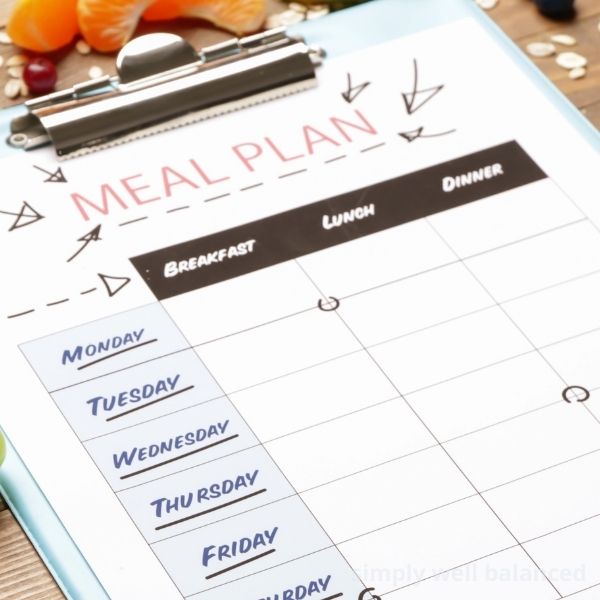
Meal planning and prepping is another way to create balance in your life as a teacher mom.
At the end of a long day, the last thing you want to do is try to decide what to make for dinner.
Creating a weekly meal plan and grocery list will take the guesswork out of what’s for dinner and make mealtime much easier.
Not only is meal planning a sanity saver, but it can also be cost-effective. When you plan meals ahead of time, you’re less likely to order in or dine out, which can get expensive quickly.
In our home, I focus on not only planning, but also prepping meals ahead of time. I often use Sunday evenings to prep a weeks worth of lunches for myself and at least one weeknight dinner. Having dinner planned for an entire week is a huge relief and removes a nightly burden that I used to dread.
Action Step: Make a weekly meal plan and corresponding grocery list.